

20+ year of experience
Trial ready
Personal attention
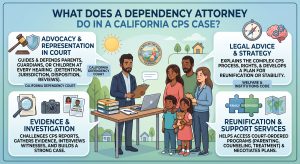
When Child Protective Services (also known as CPS) contacts your family, the situation can move quickly. A social worker from CPS or DCFS may request interviews, inspect your home, ask you to sign a safety plan, or recommend that your child be removed. A dependency attorney protects your rights during the investigation and represents you if the case proceeds to juvenile dependency court.
Juvenile dependency is a specialized area of California law. It is different from family court and criminal court, even when the same allegations affect more than one proceeding. A lawyer who regularly handles dependency matters understands the agencies, hearings, evidentiary issues, and strict timelines that can determine whether a family remains together.
A dependency attorney is a lawyer who represents a parent, guardian, caregiver, or child in a juvenile dependency matter. These cases generally begin when a county child welfare agency alleges that a child falls within one or more grounds listed in California Welfare and Institutions Code section 300. See Cal. Welf. & Inst. Code § 300 (West 2026).
In Orange County, the agency is the Social Services Agency, commonly called SSA. Other counties use different names. Los Angeles County, for example, uses the Department of Children and Family Services, commonly called DCFS. Although agency names vary, the court process is governed by California dependency law.
A dependency attorney may become involved before the agency files a petition. Early representation can be especially important because statements, home visits, safety agreements, medical records, and interviews conducted during the investigation may shape the agency’s later decisions. Learn more about defense during an Orange County CPS investigation.
The attorney’s first task is to learn what the agency is investigating and what immediate risks the family faces. Depending on the facts, counsel may:
An investigation does not always result in a court case. Effective advocacy before a petition is filed may help the agency evaluate reliable evidence, consider less restrictive safety measures, and avoid unnecessary disruption to the family. The American Bar Association also recognizes the importance of representation during the investigation stage and identifies practical ways counsel can support parents before court proceedings begin. See Representing Parents During Child Welfare Investigations.
If the agency files a petition, a dependency attorney represents the parent at each stage of the case. Counsel reviews the reports and allegations, explains the possible outcomes, presents evidence, examines witnesses, raises legal objections, and advocates for a result consistent with the parent’s goals and the child’s safety.
The California Courts explain that when a child has been removed because of alleged abuse or neglect, the parent becomes a party to a juvenile dependency case. The court process can affect placement, visitation, services, custody, and, in the most serious cases, parental rights. See the California Courts’ official guide on what to do if your child is removed.
Families seeking a broader explanation of the process can also review the firm’s guide to juvenile dependency and CPS cases in California.
A California dependency case may include several hearings. The names and precise sequence can vary with the circumstances, but the principal stages are as follows.
Detention hearing. If a child is removed from the home, the juvenile court promptly considers whether the child should remain outside the home while the case is pending. A dependency attorney may challenge the asserted need for detention, present relatives or other placement options, request visitation, and propose conditions that address the court’s safety concerns. See Cal. Welf. & Inst. Code § 319 (West 2026).
Jurisdiction hearing. The court decides whether the agency has proven one or more allegations that bring the child within section 300. Counsel may challenge unreliable statements, incomplete investigations, unsupported expert opinions, and allegations that do not satisfy the statute. See Cal. Welf. & Inst. Code §§ 300, 355 (West 2026).
Disposition hearing. If the court sustains an allegation, it decides what orders are necessary for the child and family. The court may address placement, custody, visitation, reunification services, counseling, testing, treatment, and other case plan requirements. A dependency attorney advocates for orders that are legally supported, practical, and tailored to the family’s actual needs.
Review hearings. The court periodically reviews the parent’s progress, the agency’s efforts, visitation, the child’s placement, and whether returning the child home would be appropriate. Counsel can document compliance, address barriers to services, seek expanded visitation, and challenge inaccurate descriptions of the parent’s progress.
Permanency hearing. If reunification does not occur within the statutory period, the court may consider a permanent plan under California Welfare and Institutions Code section 366.26. Possible outcomes include adoption, guardianship, or another permanent placement. Because parental rights may be at stake, preparation throughout the case is critical. See Cal. Welf. & Inst. Code § 366.26 (West 2026).
For an Orange County focused overview of these proceedings, visit the juvenile dependency practice page.
A dependency attorney does more than appear at hearings. Strong representation requires counsel to develop the facts, understand the client’s objectives, and respond to problems as they arise. The American Bar Association’s standards for attorneys representing parents emphasize client directed representation, preparation, investigation, regular communication, and advocacy both inside and outside the courtroom. See ABA Standards of Practice for Attorneys Representing Parents in Abuse and Neglect Cases.
In practice, counsel may protect a parent’s rights by:
Parents should be candid with their lawyer. Information about prior agency involvement, substance use, domestic conflict, mental health treatment, criminal allegations, or immigration concerns may be difficult to discuss, but counsel needs accurate information to anticipate issues and provide useful advice.
A dependency attorney and a family lawyer may both handle disputes involving children, but they practice in different courts and address different legal questions.
Family court generally resolves disputes between private parties concerning divorce, custody, visitation, parentage, or support. Juvenile dependency court considers whether government intervention is necessary because a child is alleged to have suffered, or to face a substantial risk of, abuse or neglect.
The distinction matters. A family lawyer may be highly experienced in custody litigation but may not regularly handle section 300 petitions, social worker reports, reunification plans, statutory review hearings, or section 366.26 proceedings. When both courts are involved, counsel must understand how orders and evidence in one matter may affect the other. ALL Trial Lawyers provides additional information about its CPS and juvenile dependency practice.
You do not need to wait until your child is removed or a court petition is filed. Consider contacting a dependency attorney as soon as:
Early advice can help you understand what the agency is requesting, which decisions require immediate attention, and how to preserve useful evidence. It can also reduce the risk that fear, confusion, or an incomplete explanation will be treated as noncooperation.
Ask how much of the lawyer’s practice involves juvenile dependency cases and whether the lawyer regularly appears in the county handling your matter. You may also want to ask about the lawyer’s approach to investigations, contested hearings, expert evidence, emergency communication, and related criminal or family court issues.
Experience should be evaluated through verifiable information. Founding attorney Mohammad Abuershaid’s professional recognition has included selection to the 2027 Southern California Rising Stars list for a seventh consecutive year, as reported by Yahoo. Yahoo also reported his recognition by Best Lawyers: Ones to Watch in America in an article concerning his juvenile dependency practice. See Southern California Juvenile Dependency Attorney Mohammad Abuershaid Recognized by Best Lawyers.
Awards are only one consideration. The right attorney should also communicate clearly, understand your goals, identify both strengths and risks, and be prepared to advocate at every stage of the case. You can review the firm’s attorney and practice information before scheduling a consultation.
Do parents have a right to an attorney in a California dependency case?
California law provides for appointed counsel for a parent or guardian who cannot afford counsel when the statutory requirements are met. See Cal. Welf. & Inst. Code § 317 (West 2026). A parent may also retain private counsel.
Can a dependency attorney stop CPS from removing a child?
No attorney can guarantee that result. Counsel can present evidence, challenge the legal and factual basis for removal, propose protective alternatives, and ask the court to return the child or place the child with an appropriate relative. The result depends on the evidence and the child’s circumstances.
Can the same lawyer handle dependency and family court?
Sometimes, but the lawyer must be competent in each area and able to manage any conflicts. Because the proceedings follow different statutes and procedures, parents should ask specifically about dependency court experience.
What should I bring to a consultation?
Bring notices, petitions, social worker contact information, safety plans, court orders, police reports, medical records, photographs, relevant messages, and a list of possible witnesses. Prepare a clear timeline and identify any approaching hearing dates.
A CPS investigation can affect where your child lives, when you may visit, what services you must complete, and whether the government continues to intervene in your family. Getting reliable legal advice early can help you make informed decisions and prepare for what comes next.
ALL Trial Lawyers represents parents, guardians, and caregivers in Orange County CPS investigations and juvenile dependency proceedings. To discuss your situation, contact an Orange County CPS lawyer for a consultation.
This article provides general information and is not legal advice. Reading it does not create an attorney client relationship. Every dependency matter depends on its particular facts and procedural history.
All fields are required. If you need immediate assistance, do not hesitate to call us at (866) 811-4255.

Mohammad Abuershaid, professionally known as Mo Abuershaid, is the founding partner of ALL Trial Lawyers and one of California’s most trusted authorities in dependency law, juvenile dependency cases, CPS defense, and high stakes CPS cases.